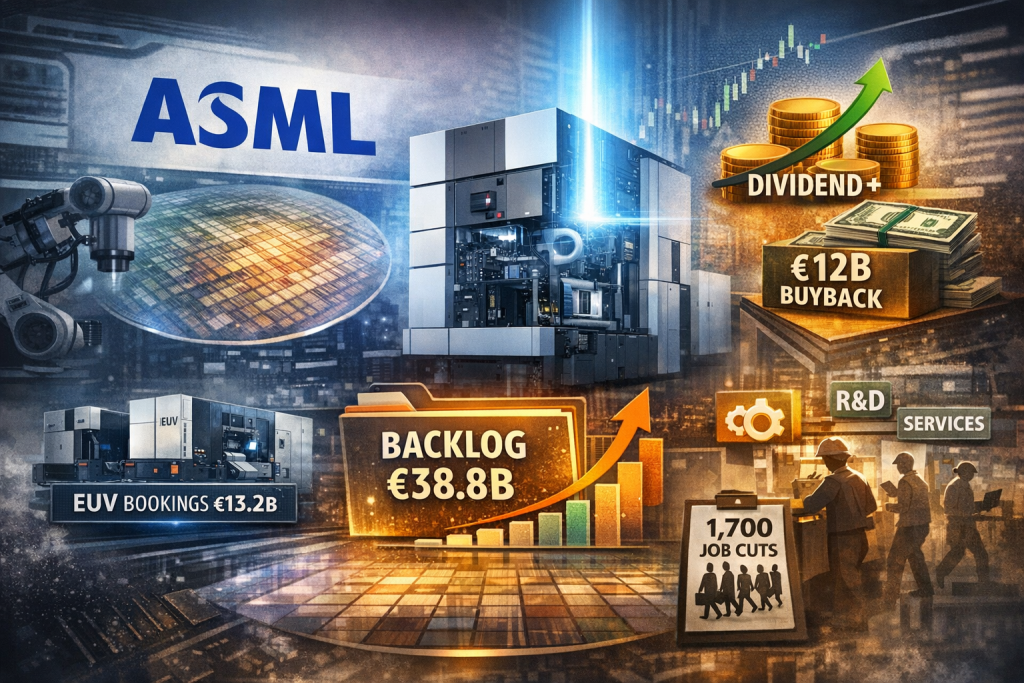
ASML stock surged 6% on Wednesday, after the Dutch semiconductor equipment maker posted record results and announced a €12 billion three-year buyback program alongside a 17% dividend hike.
While the investors focused on the capital returns, the company’s earnings revealed a much deeper story.
A backlog loaded with high-margin products and multi-year customer commitments that matter far more to long-term valuation than shareholder payouts.
ASML stock: Q4 2025 earnings
ASML reported full-year 2025 revenue of €32.7 billion with a net income of €9.6 billion, capping its 13th consecutive year of growth.
Fourth-quarter bookings crushed expectations at €13.2 billion, 89% above the analyst forecast of €6.95 billion, with €7.4 billion from its premium EUV (extreme ultraviolet) systems.
The stock’s reaction to these headline numbers was predictable.
Yet analysts and investors quickly turned attention to the €7.50 per-share dividend increase and the new buyback authorization.
These financial plumbing exercises are important for near-term earnings per share, but they are largely secondary to what ASML’s backlog reveals about the company’s true growth engine.
Backlog quality over capital returns
The real earnings story sits in the order book.
ASML ended 2025 with a €38.8 billion backlog, of which €25.5 billion (66%) is EUV equipment.
That’s roughly 16 to 17 months of revenue visibility locked in. More importantly, the composition matters enormously.
EUV machines command price tags that run into millions of dollars per unit, with newer High-NA systems priced at $380 million to $400 million each.
These orders carry longer lead times, higher gross margins, and attach substantial recurring service revenue as customers need support, upgrades, and consumables.
CEO Christophe Fouquet noted that customers have grown “notably more positive” about sustained AI-driven demand, reflected in “record order intake.”
Two High-NA systems already shipped in Q4 2025 and generated revenue recognition, a milestone signaling that the technology has passed customer validation.
Production ramps of these ultra-advanced machines will drive significant 2026 revenue upside and begin a 12-to-18-month maturity cycle where customers (Intel, Samsung, TSMC) work to yield-qualify them for volume manufacturing.
This backlog composition reshapes 2026-2027 earnings.
Guidance of €34 billion to €39 billion for 2026 implies 4 to 19% growth, with the high end powered by EUV and High-NA adoption acceleration.
The installed base business, which contributed €8.2 billion in 2025 from services and upgrades, should grow further as ASML’s EUV population expands.
Operational reality takes center stage
The €12 billion buyback authorization (through 2028) will moderately support EPS accretion but is not a growth lever.
Capital returns matter for sentiment and offset dilution from employee plans, but they don’t change the underlying business trajectory.
A company buying back shares at 50x P/E multiples is not necessarily making a shareholder-friendly decision; it’s essentially paying premium valuations to reduce share count.
The true catalysts are execution-driven like high-NA shipment cadence, service-revenue growth, installed-base margins, and customer capex resilience.
ASML also announced 1,700 job cuts (roughly 4% of the workforce), mostly in leadership roles, to reduce organizational complexity.
Success here hinges on the engineers’ ability to execute faster without disruption.
The post ASML stock: buybacks and dividends grab attention, but real signal lies elsewhere appeared first on Invezz