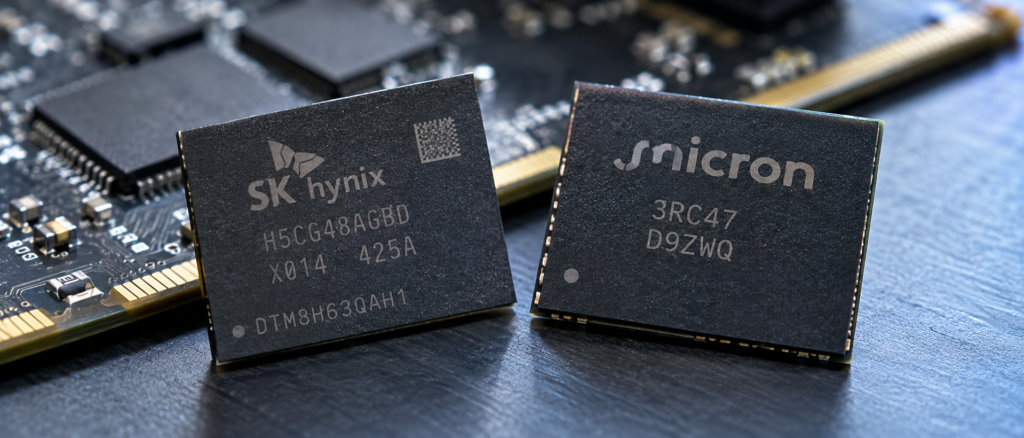
Shares of memory chipmakers Micron MU and SK Hynix continued to fall on Tuesday as concerns over China’s CXMT and its growing manufacturing capabilities persisted.
Warnings from prominent business leaders and investors about the potential competitive threat further weighed on sentiment, even as warnings from senior industry executives about the cost of financing artificial intelligence infrastructure pressured the broader chip sector.
Shares of both companies were down 4% in trading, extending Monday’s selloff, while SK Hynix shares in South Korea had also fallen more than 10% earlier in the day.
Investors have been reassessing the outlook for memory chip manufacturers after Chinese producer ChangXin Memory Technologies (CXMT) announced progress in a new memory-cell architecture that could help it increase storage density and compete more effectively with established manufacturers.
The concerns have now drawn attention from prominent investors and business leaders, including Cathie Wood and Elon Musk, who have highlighted the potential implications of China’s manufacturing scale for the global semiconductor industry.
Cathie Wood warns of deeper memory chip cycles
Investor Cathie Wood warned that China’s expanding memory chip production capacity could intensify the boom-and-bust cycles that have historically affected the sector, according to Bloomberg.
Speaking to investors in Hong Kong, Wood said ARK avoids conventional memory chip companies because the industry is vulnerable to sharp price declines when supply outpaces demand.
She suggested that additional Chinese capacity could make these swings more severe.
“The trend is up, but the cycles are vicious,” Wood said, according to Bloomberg.
If “you get a few more incremental competitors, especially out of China, the volatility will increase.”
Wood identified state-backed Chinese manufacturers such as CXMT as a potential source of additional supply pressure.
The company has expanded its DRAM production as it seeks to capture a larger share of the market.
Although high-bandwidth memory (HBM), which is used in advanced AI accelerators, remains in strong demand, a broader increase in Chinese memory production could put pressure on prices and margins across the industry.
CXMT advances its new memory architecture
CXMT has announced “key progress” in developing a new memory-cell architecture intended to increase storage density, a technology also being pursued by Samsung Electronics and SK Hynix.
CXMT President Cao Kanyu said at an industry event in Shanghai over the weekend that the company planned to introduce a new server-memory product based on the technology by the end of 2026, according to a company statement.
The development centres on a “4F square” design, in which each memory cell occupies an area equivalent to four square units of F, with F representing the minimum line width used in a semiconductor manufacturing process.
Mainstream commercial dynamic random-access memory (DRAM) currently uses a 6F square-cell structure.
Moving to a 4F square architecture could allow manufacturers to fit more memory cells onto a chip, increasing storage density and potentially improving manufacturing efficiency.
The extent to which the development threatens established manufacturers will depend on CXMT’s ability to scale production, deliver competitive products and win customers.
Elon Musk highlights China’s manufacturing scale
SpaceX chief executive Elon Musk added to the discussion, pointing to China’s ability to scale production once it has developed a commercially viable technology.
“When China figures out how to manufacture a product, their ability to scale is often greater than the rest of the world combined. We saw this with lithium batteries and solar, for example,” Musk said on X.
He was responding to a post by Milk Road analyst Melvin about the memory chip selloff, which questioned whether CXMT had demonstrated that it could manufacture at scale.
Musk described SpaceX as an exception in the space industry, noting that China accounted for a majority of non-SpaceX mass to orbit.
He added that memory chips could follow a different trajectory, while cautioning that more advanced architectures would be harder to develop.
“Maybe RAM will be different, but RAM was a low-margin commodity only ~3 years ago. LP5 and LP6 are designed to a common standard that China seems to be solving fast.”
“Newer HBM architectures and things like an SRAM layer below logic and 3D stacking RAM on top of logic while finding a way to keep the logic cooled will be harder to solve,” he said.
CXMT gains share, but HBM remains a key distinction
A Counterpoint Research report published last month showed that CXMT captured 10% of the global DRAM market in the second quarter of 2026, compared with 4% in the same period a year earlier and 8% in the first quarter.
The increase has strengthened concerns about the competitive pressure facing established memory manufacturers.
Phillip Wool, chief market strategist at Rayliant Global Advisors, said CXMT’s progress represented a significant milestone for Chinese chipmakers and demonstrated their ability to overcome technology restrictions.
However, he argued that the market reaction appeared disproportionate to the immediate competitive threat, given that CXMT had yet to demonstrate large-scale production and continued to trail Samsung and SK Hynix in market share.
“More importantly, we’re not even talking about HBM here, and the Korean chipmakers are still unquestionably dominating that space, with very little threat at all from the likes of CXMT or anyone else for the foreseeable future,” Wool said.
HBM is particularly important for advanced AI accelerators because it allows processors to access large volumes of data at high speeds.
Nevertheless, CXMT’s ambitions in the segment are also attracting attention.
The Information reported in August that the company had begun producing advanced HBM in small quantities.
CXMT plans to expand that production in 2027, while Alibaba’s T-Head semiconductor unit and Chinese AI chip designer Cambricon are already testing its HBM products with their processors.
AI infrastructure financing adds to investor concerns
Separately, warnings from semiconductor executives about the availability and cost of capital have added another source of uncertainty for investors betting on the AI infrastructure boom.
Broadcom chief executive Hock Tan said access to capital could become one of the biggest constraints on industry growth, even as demand for computing infrastructure continues to exceed supply.
“[What] I think might be the biggest constraint is capital,” Tan said at the DBS Asia Future Forward Conference in Singapore on Monday.
Intel chief executive Lip-Bu Tan echoed those concerns, highlighting the rising cost of capital and questions about whether companies investing heavily in AI will ultimately generate sufficient returns.
“If there’s any challenge in the front, it’s capital and the cost of capital, and then the other part is in the longer run, people want to see the ROI,” he said.
The comments have heightened concerns that higher bond yields could make data centre construction and semiconductor purchases more expensive.
For memory chip manufacturers, the combination of potential new competition, cyclical pricing risks and uncertainty over the financing of AI infrastructure has created a more complicated outlook, even as demand for advanced computing capacity remains strong.
The post Micron, SK Hynix stocks continue fall on CXMT threat; Cathie Wood, Musk weigh in appeared first on Invezz